

Free Daily Email Spurgeon Devotions

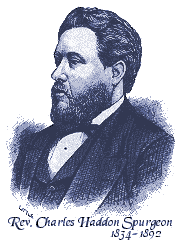
Charles Haddon Spurgeon: A Brief Biography
- By Professor Robert H. Ellison, East Texas Baptist University
(Brief Timeline)
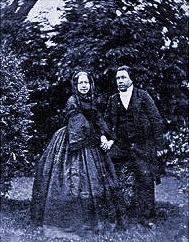
Charles Haddon Spurgeon, Victorian England's best-known Baptist minister, was born on June 19, 1834 in Kelvedon, Essex and spent his childhood and early teenage years in Stambourne, Colchester, and Newmarket. In 1856 he married Susannah Thompson; their only children, twin sons Thomas and Charles, were born on September 20, 1857.
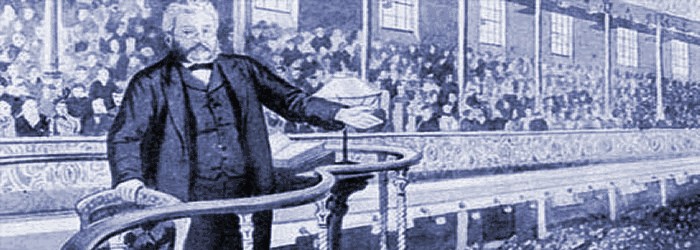
Spurgeon had no formal education beyond Newmarket Academy, which he attended from August 1849 to June 1850, but he was very well-read in Puritan theology, natural history, and Latin and Victorian literature. His lack of a college degree was no hindrance to his remarkable preaching career, which began in 1850, when he was only fifteen years old. A few months after his conversion to Christianity, he began preaching at Teversham. The next year, he accepted his first pastorate, at the Baptist Chapel in Waterbeach. The church quickly grew from fewer than a dozen congregants to more than four hundred, and Spurgeon's reputation as a preacher caught the attention of New Park Street, London's largest Baptist church. He was invited to preach there in December 1853 and, following a brief probationary period, he agreed to move to London and become the church's new pastor.
Spurgeon's New Park Street congregation grew rapidly as well, soon becoming too large for the 1200-seat auditorium. On August 30, 1854, the membership agreed to enlarge the chapel; during the remodeling, services were held at the 5,000-seat Exeter Hall, a public auditorium in Strand Street. The renovations to New Park Street were complete in May 1855, but the chapel was still too small, and in June a committee was formed to oversee the construction of the church's new home, the 5,000-seat Metropolitan Tabernacle. The congregation moved once again, meeting in Exeter Hall and the 8,000-seat Surrey Gardens Music Hall until the Tabernacle was dedicated on March 18, 1861.
Spurgeon began publishing shortly after he started preaching. In January 1855, Passmore and Alabaster inaugurated the "Penny Pulpit," publishing one sermon every week; the series continued until 1917, a quarter-century after Spurgeon's death. Every year these sermons were reissued in book form, first as The New Park Street Pulpit (6 volumes, 1855-1860) and later as The Metropolitan Tabernacle Pulpit (57 volumes, 1861-1917). Spurgeon published scores of religious books in addition to his sermons; the most significant works include Lectures to My Students (1890), a collection of talks delivered to the students of his Pastors' College, and the 7-volume Treasury of David (c. 1869), a best-selling devotional commentary on the Psalms.
Spurgeon's work in London was not limited to preaching and sermon-publishing. He also served as president of the Pastors' College, which he founded in 1857; established the Stockwell Orphanage, which opened for boys in 1867 and girls in 1879; and oversaw evangelistic and charitable enterprises such as almshouses, organizations for distributing food and clothing to the poor, and a book fund for needy ministers.
Spurgeon's preaching was both enormously popular and highly controversial. Some regarded him as the greatest orator since Whitefield; others criticized him as theatrical, awkward, and even sacrilegious. Two of his most controversial works were his "Baptismal Regeneration" sermon and his "Down Grade" articles. On June 5, 1864, he preached a sermon entitled "Baptismal Regeneration," objecting to Anglican teachings on the sacramental power of infant baptism. Over 350,000 copies were sold, and the furor it provoked led to Spurgeon's withdrawal from the Evangelical Alliance, an ecumenical association of Dissenters and Evangelical Anglicans.
The "Down Grade" controversy began in 1887, when Spurgeon published a series of articles declaring that evolutionary thinking and liberal theology threatened to "Down Grade" the church. In this case, he was concerned not with Anglican teaching, but with what he believed to be doctrinal error, particularly Unitarian ideas, within the Baptist Union. He discussed his concerns in private letters to ministers such as Samuel Booth and Joseph Parker and in several articles published in The Sword and the Trowel, the Metropolitan Tabernacle's monthly periodical. When these articles did not receive the response Spurgeon wanted--the matter was not discussed at the Union's 1887 meeting in Sheffield and some members of his own congregation dismissed or made light of it--he concluded that he had no choice but to resign from the Union, which he did on October 28.
Illness forced Spurgeon to keep a low profile during the last few years of his life. He preached his final sermon at the Metropolitan Tabernacle on June 7, 1891. He died in France on January 31, 1892; on February 9, over 60,000 people filed past his casket in the Tabernacle. He was buried at Norwood Cemetery on February 11.
Used by permission: August 10, 2002.
 For other great works, especially from this era, please visit http://www.victorianweb.org/.
Or, select any of the links in the text above.
For other great works, especially from this era, please visit http://www.victorianweb.org/.
Or, select any of the links in the text above.
